“What if I could make my heart’s response to exercise visible?”Siyaa · project motivation
THOUGHT→RESEARCH→SOLUTION→TECHNOLOGY
01
Thought
Basketball, rugby and karate made me notice that my heart seems to respond differently to different activities. News stories about deaths during or after exercise also sparked my curiosity.
What if I could make my heart’s response to exercise visible?
02
Research
A personal observation became a question: do different people respond differently to the same exercise? I began with a question, not an answer.
What can age and exercise type help explain?
03
Solution
To investigate, I needed a consistent way to capture heart-rate samples, guide an exercise session, calculate changes and make recovery patterns visible.
Make the invisible measurable.
04
Technology
That need became Siyaa’s PulseLab: an Apple Watch and iPhone research platform, with timestamped measurements, calculations and graphs.
One study. A connected platform.
News stories sparked curiosity, not a medical hypothesis about deaths. PulseLab does not predict sudden death, diagnose disease or determine whether exercise is safe.
Personal account supplied by Siyaa in the website brief; research identity and progression documented in PROJECT.md.
02 THE RESEARCH
One question. Two connected investigations.
SCIENTIFIC QUESTION
To what extent do age and exercise type explain individual differences in heart-rate response and recovery following standardized exercise?
TECHNOLOGY QUESTION
Can my student-developed Apple Watch and iPhone system reliably measure, analyze, and interpret individual heart-rate response and recovery during standardized exercise?
Scientific subquestions
How does percentage heart-rate change differ across standardized exercise types?
How strongly is age associated with heart-rate response and recovery?
Does exercise type modify the relationship between age and heart-rate response?
How much individual variation remains after accounting for age and exercise type?
Technology questions: implementation is not validation
Collect and transfer timestamped HR reliably?
Implemented; physical transfer validation remains.
Calculate reproducible response and recovery metrics?
Versioned derivations and automated tests are implemented.
Provide consistent, rule-based educational suggestions?
Disabled. Thresholds and rules are not approved.
Establish accuracy and repeated-trial repeatability?
Not established: no reference device and one session per person.
Variables & limits
Explanatory variables
Exact age and exercise type; exercise position is a control term. Age is observed, not experimentally assigned.
Measured outcomes
HR samples and derived response/recovery: BPM increase, percentage increase, one/two-minute recovery and confirmed threshold time.
Standardized controls
Five-minute seated baseline, 30-second duration, same study Watch and fit check, indoor testing, consistent instructions and counterbalanced orders.
Known variation
Comfortable self-selected pace, caffeine and differences between similar staircases remain limitations. Sex/activity/anthropometrics are exploratory.
Current hypothesis status
No finalized hypothesis for the current Beyond the Beat question is recorded in the reviewed authoritative documents. Siyaa should write and confirm it before presenting it; the earlier project’s prediction is not silently reused.
Jog in place with alternating knees and upright posture. Raise each knee toward hip height only as comfortably possible. No forced height or unnecessary jumping.
30 seconds
Stair Climbing
02
Climb a normal flight and walk back down, repeating for 30 seconds at a controlled pace. Enter the number of stairs in the flight beforehand; this is not a count of steps performed.
30 seconds
Sitting Toe Touches
03
Sit on the floor with legs extended. Reach comfortably toward the toes and return upright. A slight knee bend is allowed; do not force the stretch or bounce.
30 seconds
Exercise safety and setup
For stairs, the documented protocol requires similar normal flights, clear dry surroundings, no handrail use and a nearby adult. Anyone unable to perform without support does not perform this exercise. Stop safely when the timer ends; do not rush on the stairs.
Stop for pain, dizziness, loss of balance or discomfort. No app HR value determines medical fitness or clearance.
Use the same physical Watch with a snug, comfortable fit. Testing is indoors; avoid vigorous exercise for 30 minutes beforehand. Comfortable pace is not controlled intensity, and caffeine is an uncontrolled limitation.
Exact age remains the main variable; groups guide balance and simple charts.
RECRUITMENT GOALS, NOT ENROLMENT
50male · planned
50female · planned
The sex-balance goal is supplied in Siyaa’s current website brief. The app also permits “another sex variation” and “prefer not to answer”; this goal is not a new eligibility exclusion.
One session per participant. The 100-person goal is not a minimum for descriptive analysis or proof of adequate statistical power.
Exact-age planned distribution
The documented recruitment targets are overridable. Actual age is never altered to meet a target.
Planned targets from the study plan, mirrored by generator assignments
Exact age
Target count
12
5
13
4
14
4
15
4
16
4
17
4
18
3
19
2
20
2
21
2
22
2
23
2
24
2
25
2
26
2
27
2
28
2
29
2
30
3
31
3
32
3
33
3
34
3
35
2
36
2
37
2
38
2
39
2
40
3
41
3
42
3
43
2
44
2
45
2
46
2
47
2
48
2
49
2
50
2
Participant fields and exploratory variables
Anonymous sequential ID; exact age; sex; activity category; height and weight; assigned exercise order; automatically recorded session time; protocol deviations. No participant names.
Activity: low <1 hour/week; moderate about 1–4; high >4 hours/week of moderate/vigorous activity. Height is saved in cm and weight in kg regardless of entry units. Sex, activity and anthropometrics remain exploratory.
Anonymous ID, exact age, unit-normalized fields, assigned order and participant confirmations.
02
Initial rest
5 minutes
Sit quietly. Derive resting HR from the median of actual samples in the final 60 seconds.
03
Exercise
30 seconds
The visible countdown and the same music start and stop together. Music does not set pace.
04
Adaptive recovery
At least 2 minutes
HR at or below 110% of resting for 30 confirmed seconds. Repeat exercise/recovery for the assigned sequence.
05
Complete & verify
After final recovery
Save the session and verify transfer completeness. Missing Watch samples leave research metrics provisional.
The 110% recovery threshold is an operational study rule, not a medical cutoff or clearance to exercise.
Six orders, rotated extra places
Planned participants per order and age group
Order
Exercise sequence
12–17
18–29
30–39
40–50
1
Knees → Stairs → Toes
5
4
4
4
2
Knees → Toes → Stairs
4
5
4
4
3
Stairs → Knees → Toes
4
4
5
4
4
Stairs → Toes → Knees
4
4
4
5
5
Toes → Knees → Stairs
4
4
4
4
6
Toes → Stairs → Knees
4
4
4
4
Totals across groups: 17, 17, 17, 17, 16, 16. Counterbalancing reduces sequence confounding; it does not remove every order effect.
What happens when a session is interrupted?
Participant stop/discomfort: terminate. Interrupted or shortened exercise, stopped collection or phone termination: mark incomplete and terminate; do not silently repeat or resume the same exercise.
Interrupted baseline: restart baseline. Interrupted recovery: continue recovery and restart its confirmation window.
A disconnected phone can continue with a deviation only while Watch collection remains active. Reliable background timing can continue with a deviation; unreliable exercise timing stops the session. Music/timer failure during exercise marks it incomplete. Device behaviour still needs physical validation.
Manual snapshots would miss the recovery curve. PulseLab links a guided protocol with timestamped acquisition, consistent calculations and graphs, while keeping the measurements distinct from interpretation.
Acknowledgements and retries carry batches to iPhone. Source and phone-receipt timestamps remain separate. The final sequence manifest verifies completeness.
Separate mode directories, atomic protected writes, protocol events, deviations and immutable sample append rules. Research is never filled with synthetic samples.
Explore the complete data path without interaction
Apple Watch: HealthKit workout-session access and an anchored HR query collect delivered optical heart-rate samples. True sensor cadence remains system-controlled.
Watch buffer: Timestamped source samples are saved locally, deduplicated and numbered per session before ordered batch transfer.
WatchConnectivity: Acknowledgements and retries carry batches to iPhone. Source and phone-receipt timestamps remain separate. The final sequence manifest verifies completeness.
Study storage: Separate mode directories, atomic protected writes, protocol events, deviations and immutable sample append rules. Research is never filled with synthetic samples.
Metrics engine: C1 calculations read original samples and events. Values preserve protocol version and input revision; late inputs produce new derivations.
Graphs & analysis: Swift Charts displays source-derived outcomes. Scientific analysis reads metrics; unapproved educational suggestions remain disabled and cannot write back to source data.
Source timestamps and receipt timestamps are stored with millisecond precision. Timestamp precision does not mean a new sensor sample each second or millisecond. No fabricated values fill gaps.
08 CALCULATIONS
The numbers behind the graphs.
Resting reference
R = median(HR in final 60 s of baseline)
A typical value from the final minute, calculated from actual delivered samples, not a separate sensor reading.
The share of the initial rise that has fallen by the chosen landmark. Unavailable when I ≤ R; not capped at 100%.
ILLUSTRATIVE SYNTHETIC EXAMPLE
Synthetic (140 − 105) / (140 − 70) × 100 = 50%.
Confirmed threshold time
T = confirmation end time − exercise end time
First completed 30-second interval with delivered HR at or below 1.10 × R. A gap longer than 5 seconds resets confirmation.
ILLUSTRATIVE SYNTHETIC EXAMPLE
Synthetic R = 70 → threshold 77 BPM. Eligible readings remain ≤77 from 80 to 110 s → T = 110 s. The next exercise still waits until at least 120 s.
Endpoint rules and missingness
R is resting reference; I is immediate post-exercise HR; HR(t) is the actual HR sample nearest the one- or two-minute target.
Landmark tolerance is ±1 second. The sample’s actual timestamp and offset remain attached. Missing baseline or endpoint samples mean an unavailable metric, not a fabricated substitute.
Threshold time includes the confirmation interval. It is distinct from total recovery phase duration, which also enforces the 120-second minimum and adult-review decision.
Paired observations, exercise means and descriptive 95% Student-t intervals.
Exact-age response
Age scatter plots and trends for each exercise and selected outcome.
Age × exercise
Order-adjusted curves, slopes and differences from a participant random-intercept REML model.
Individual variation
Observed versus fixed predictions, participant residuals, variance components and residual checks.
Exploratory comparisons
Sex, activity level and anthropometrics stay secondary to the primary question.
Collection quality
Available metrics, visible sample gaps, deviations and source-to-receipt delay. These do not prove sensor accuracy.
The model and its limits
outcome ~ centered exact age × exercise
        + categorical exercise position
        + (1 | participant)
Native random-intercept REML, approximate 95% Wald intervals and no automatic significance, p-values or causal claims. More than eight usable participants and a full-rank design are numerical prerequisites, not proof of statistical power.
Assumptions, missingness, influential observations and final interpretation still need scientific review. Descriptive charts can update from the first participant.
Real Watch source. Participant controls and supported protocol required. Separate local store; unverified transfer remains provisional.
TEST DATA
Synthetic validation
100 generated participants and accelerated development sessions. Never counted as research. Deterministic and separately stored.
DEMO
Reserved, unavailable
A separate data domain exists, but the visitor experience is parked. It is not an active study or testing mode.
100synthetic participants
2,700finite main-fixture metric values
41core cases passed in recorded app run
What the test dataset exercises
Graphs, selectable outcomes, age groups, exercise and exploratory sex/activity comparisons, recruitment counts and saved-data reopening use a complete 100-person fixture. The fixture uses production calculations on generated source samples and events.
Eleven controlled scenarios cover response/recovery extremes, missing samples away from landmarks, delayed receipt, disconnect/reconnect and interrupted recovery. Additional failure fixtures preserve unavailable endpoints and incomplete sessions.
The latest app log records a clean combined simulator build, 41 core tests and the 100-person chart UI flow. The 60-person numerical fixture agrees with an independently fitted statsmodels model within test tolerances. These are platform checks, not human-study results.
Still to validate on physical devices: HealthKit permission and sensor cadence, paired transfers, battery cost, phone lock/background behaviour and backup authentication/recovery.
11 RESPONSIBILITY
Safeguards with a reason.
Implemented
Anonymous setup
Protects: Participant privacy
No names are needed to study HR differences. Sequential IDs replace identity in research records.
The documented handling rule keeps research records out of code repositories, prompts and external AI tools. This site includes only selected simulator images and summaries.
Guiding-teacher approval was reported on October 3, 2026. The workspace still requires the specific supervisor identity, role and date in the Youth Science Canada information/consent document. No additional regional approval is invented here.
The plan defers separate exercise permission; the current app requires it. That discrepancy is visible for Siyaa’s review before live research, rather than silently changing either document or code.
12 MEASURED WORK
An effort record you can trace.
38
App Swift files
Files ending .swift under App/ only; generated outputs, tests, website and historical AI tools excluded.
Unique captured build operation IDs ending in success across project history, from the corrected development evidence summary. Includes tooling checks as well as app work. Repeated runs count separately; this is not a test-case count, and unrecorded activity is unknown.
Unique captured test operation IDs ending in success across project history, from the corrected development evidence summary. Includes tooling checks as well as app work. Repeated runs count separately; this is not a test-case count, and unrecorded activity is unknown.
Build-time snapshot: 2026-10-05 UTC. No hours or uncaptured activities are estimated. Successful app checks are reported as dated evidence, not inferred from test definitions.
A reproducible snapshot of app source, tests, versions and Git history.
Recomputed by website build
No matching artifacts. Try another category or clear the search.
These are curated public-safe summaries of real workspace artifacts, not unredacted source-document exports. Each opens a document with source locations and hashes. Raw prompts, consent forms, developer logs and study databases are excluded.
14 DEVELOPMENT JOURNEY
Problems became better questions.
Documented investigations, corrections and remaining checks. Technical takeaways are not invented personal reflections.
A recovery value that never appeared
Problem
Fixed synthetic recovery windows left time-to-threshold unavailable.
What was investigated
Compared generated recovery traces with the actual confirmation rule and metric derivation.
What changed
Generated complete adaptive recovery, added review events and checked all 2,700 main-dataset values before saving.
Technical takeaway · for Siyaa to reflect on
Technical takeaway: complete test fixtures must follow the production protocol, while failure fixtures must preserve missingness.
Original delivered HR samples, actual source/receipt times and recorded protocol events.
02
Calculated metrics
Versioned transformations of source data. They can be recalculated without editing measurements.
03
Scientific analysis
Comparisons, model estimates and diagnostics. Interpretation requires real evidence and reviewed assumptions.
04
Educational output
Separate, rule-based and non-medical. Suggestions remain disabled until rules are approved.
Synthetic generator patterns validate software. Observations require actual measurements; scientific conclusions require collected evidence and reviewed analysis. A graph alone cannot establish causation or a medical conclusion.
Every image is an existing simulator capture. Synthetic records and charts demonstrate the app, not findings from people.
SIMULATOR / TEST DATA
Home & study entry
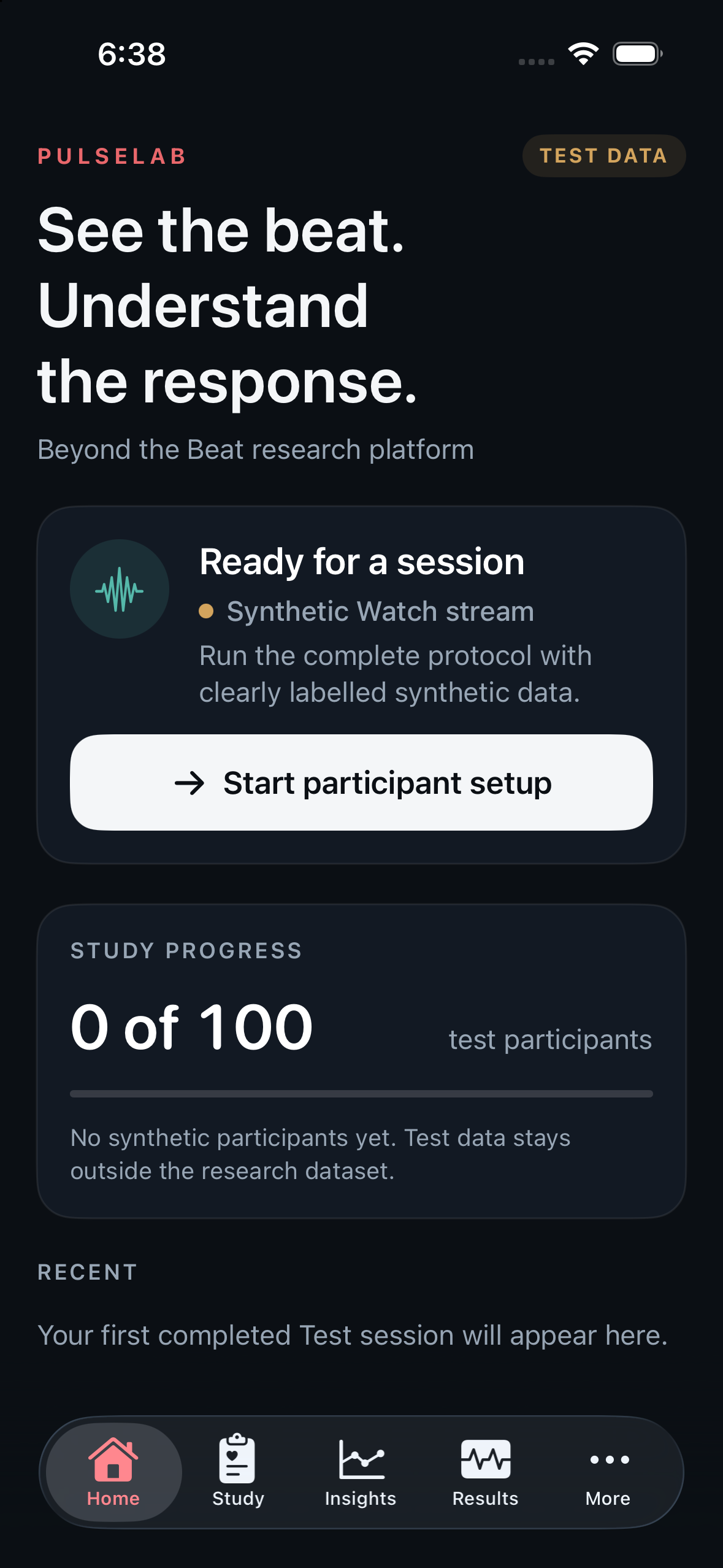
Earlier Test Mode Home, before synthetic records were loaded. The app and website share the charcoal, coral and teal palette.
SIMULATOR / TEST DATA
Anonymous participant setup
Actual Test Mode simulator setup: anonymous ID, exact age, activity categories and unit controls. Shown fields are synthetic, not participant data.
SIMULATOR / TEST DATA
Guided initial rest
Accelerated Test Mode baseline with live synthetic HR and visible stop controls. This short countdown is not the five-minute research baseline.
SIMULATOR / TEST DATA
Watch readiness
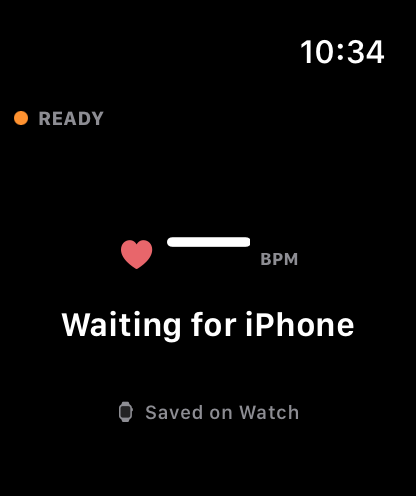
Watch simulator waiting for the phone. No sensor reading is present; this image does not demonstrate live physical transmission.
SIMULATOR / TEST DATA
Exercise comparison
Actual 100-person synthetic Insights: available-case means and paired observations. These are platform-validation patterns, not research findings.
SIMULATOR / TEST DATA
Age × exercise model
Actual synthetic adjusted curves and slope intervals. Approximate uncertainty belongs to the fitted means, not individual medical predictions.
SIMULATOR / TEST DATA
Complete recovery metrics
Source-derived values from a synthetic session, including confirmed threshold time. These numbers are not observations from a real participant.
17 PROJECT TIMELINE
A record of how it developed.
Earlier work asked whether age and exercise changed HR. This project extends that question to recovery, individual variation and the engineering needed to observe it.
Development evidence foundation
Private evidence capture and reproducible metric tooling were added to this repository.
Dates come from current-repository commits and dated project records. The earlier heart-rate project is described in PROJECT.md, but its date is not documented here; no earlier workspace was accessed.
18 TECHNICAL NOTEBOOK
Details for a closer look.
Module responsibilities
Research Governance
Validates mode, protocol and participant confirmations.
Participant
Anonymous fields, units and assigned exercise order.
Protocol & Exercise
State machine, instructions, countdown, music and interruptions.
HR Acquisition
HealthKit, Watch buffer and WatchConnectivity.
Study Data & Storage
Raw samples, events, deviations and versioned records.
Metrics & Calculations
Read-only source derivation into revisioned metrics.
Scientific Analysis
Reads available metrics; does not change source data.
Readiness, modes, settings, authenticated backup and restore.
Versions, revisions and one-way data dependencies
P1-draft is the development protocol identifier; P1 is the registered research identifier. C1 identifies current metric calculations; random-intercept-reml-v1 identifies the analysis fit. These are identifiers in code, not proof that a study has been activated.
Governance + participant setup → session protocol → acquisition → raw storage → C1 metrics → analysis → results. The Watch stores samples before transport. Each stored session retains a governance snapshot and protocol/calculation provenance.
Newly arrived raw samples advance the input revision. New derived values are appended for that revision; previous derivations remain. Analysis excludes incomplete/provisional data and does not pool incompatible versions. Educational output has no write path to raw data.
What remains intentionally parked
Final educational suggestion thresholds and rules
Missing-sample interpolation and final stale-sample definition
Replacement-device/Mac backup-key recovery
Final retention duration and deletion audit
Visitor/Demo experience
Final scientific assumption, influence and uncertainty review
Physical Watch cadence, transfer, battery and permission validation
No real participant findings are included in the project artifacts reviewed for this site. This section will be populated after research collection and scientific review. Synthetic charts appear only as Test Data / Platform Validation.
No enrolment total or research finding is inferred from Test Mode counts. Publication of future results requires an aggregate, privacy-reviewed dataset and scientific interpretation.
20 WHAT I LEARNED
Reflection belongs to the researcher.
In Siyaa’s own words.
What changed in your thinking? Which decision was hardest? What would you test differently next time?
Private local draft only. Text stays in this browser; it is not published or sent to a server. Do not enter participant details. Download your draft to keep a separate copy.